
Market Research Report
Expanding into New Markets: Key Challenges for Business Owners
Expanding into new audiences and international markets is one of the most significant growth opportunities available to modern businesses, yet it remains one of the most complex undertakings. Whether a company is a small startup targeting a new demographic or a mid-size enterprise entering a foreign country, the path is littered with strategic, regulatory, cultural, and financial obstacles.
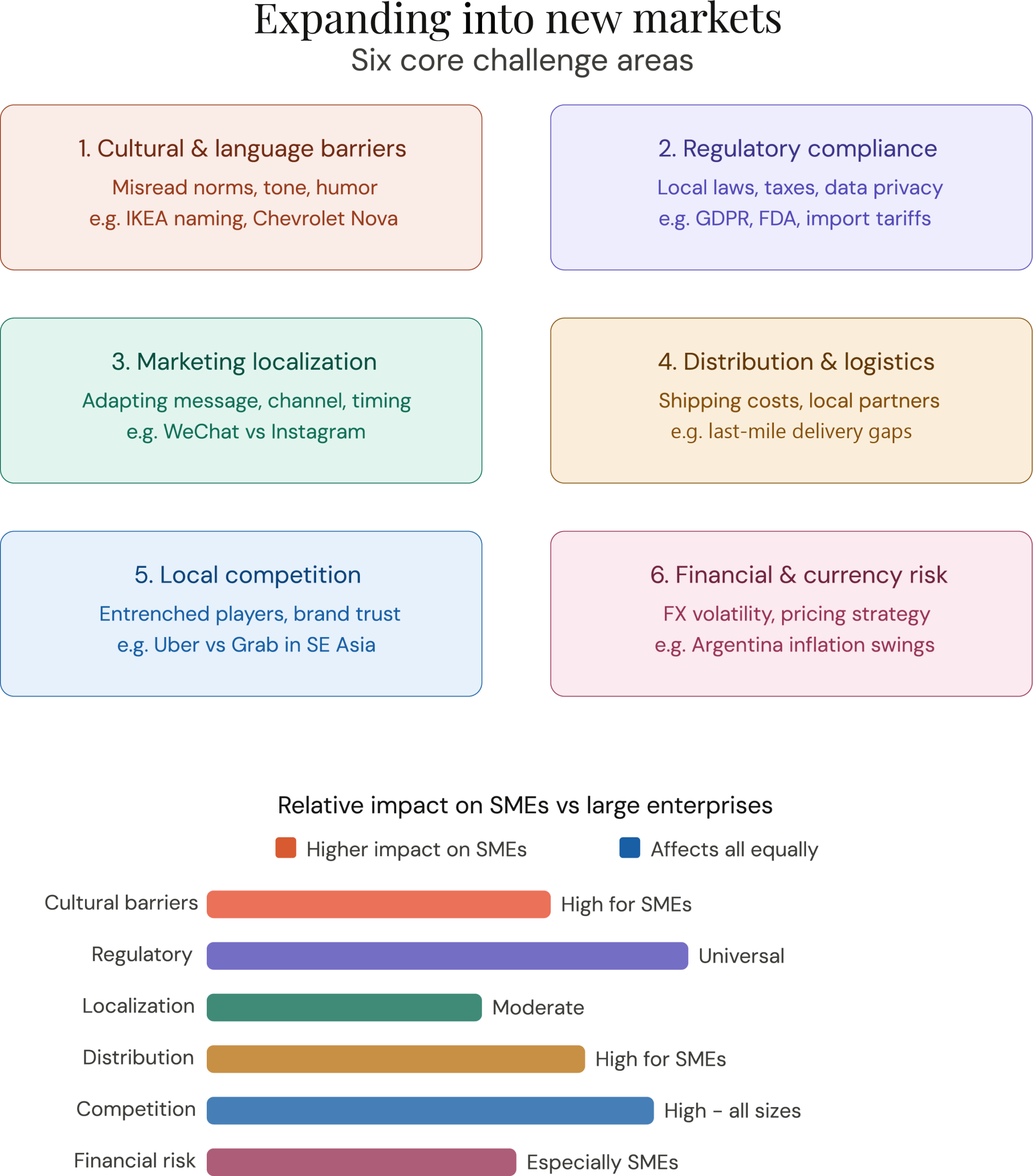
Cultural & Language Barriers
Culture shapes every aspect of how a brand is perceived, from the language and tone of its messaging to the colors on its packaging and the humor in its advertising. Businesses that fail to account for these nuances often alienate their target audience before a single transaction takes place.
Language barriers extend far beyond literal translation. Idiomatic expressions, colloquial language, and culturally loaded terms can carry entirely different connotations across markets. In high-context cultures (such as Japan, China, or much of the Middle East), unspoken social norms and relationship-building carry far more weight than in low-context cultures like the United States or Germany.
Real-world examples
- Swatch "slanted eye" ad campaign: Last year 2025, Swiss watchmaker Swatch issued an apology and removed an advertisement showcasing a model pulling at the corners of his eyes, following backlash from Asian social media users..
- Chevrolet Nova: The car's name translates to "doesn't go" in Spanish, creating a branding challenge in Latin American markets.
- IKEA product names: The world's largest furniture retailer has given some of its products names that may have unintended offensive meanings in various languages.
- McDonald's menu localization: The company adapts its menu extensively per country, offering McAloo Tikki in India and Teriyaki Burgers in Japan.
Relative impact intensity
75% — High for SMEs
Regulatory Compliance
Every market operates within its own legal and regulatory framework. From data privacy legislation to product safety standards, import duties, and employment law, the compliance landscape can be overwhelming for businesses entering unfamiliar jurisdictions.
Non-compliance is not merely a financial risk it can result in product bans, reputational damage, or forced market exits. Regulatory requirements can also shift rapidly in response to political change, requiring businesses to maintain ongoing legal monitoring.
Real-world examples
- GDPR (EU): Any business collecting data from EU residents must comply with strict data protection rules, regardless of where the company is based.
- FDA regulations (US): Food, pharmaceutical, and cosmetics companies must meet extensive approval processes before selling in the US market.
- Import tariffs & trade barriers: Countries may impose sudden tariffs on certain goods, as seen in recent US-China trade tensions.
Relative impact intensity
90% — Universal impact
Marketing Localization
Effective marketing in a new market requires far more than translating existing campaigns. Channel preferences, media consumption habits, influencer culture, and purchasing psychology differ significantly across regions. A campaign optimized for Instagram and email in the US may need to be rebuilt entirely for WeChat and short-video platforms in China.
Timing and seasonality also play a critical role. Promotional campaigns must be sensitive to local holidays, cultural events, and even political contexts. Tone-deaf campaigns particularly around sensitive periods can cause lasting brand damage.
Real-world examples
- WeChat vs Instagram: In China, Instagram and Facebook are blocked; brands must build their presence on WeChat, Weibo, and Douyin instead.
- Ramadan campaigns in MENA: Advertising during Ramadan must reflect values of community, generosity, and restraint — not promotions alone.
- Color symbolism: White represents mourning in parts of Asia, while red symbolizes luck — opposite to many Western associations.
Relative impact intensity
62% — Moderate impact
Distribution & Logistics
Having a great product and a compelling brand means little if you cannot reliably get the product to the customer. International logistics introduces a layer of complexity that domestic operations rarely face: customs clearance, last-mile delivery challenges, cold chain management, local warehousing, and fragmented retail networks.
In many emerging markets, infrastructure limitations make distribution unpredictable and expensive. Businesses often need to build entirely new supply chain models rather than simply extending existing ones.
Real-world examples
- Last-mile delivery in Brazil: High logistics costs, customs complexity, and infrastructure gaps make Brazil one of the most expensive markets to distribute goods in the world.
- India's fragmented retail: Most consumer goods in India still move through millions of small 'kirana' stores, requiring local distribution partners.
- Cold chain in Africa: Food and pharmaceutical companies face major cold chain gaps in Sub-Saharan Africa, limiting product viability.
Relative impact intensity
70% — High for SMEs
Local Competition
Entering a new market almost always means competing against established local players who possess significant home-field advantages: deep brand loyalty, existing distribution relationships, cultural credibility, and often strong government or regulatory connections.
Local competitors understand their customers at a granular level and can respond to market changes faster. Foreign entrants, by contrast, often underestimate the resilience and agility of domestic rivals, leading to failed or costly market entry strategies.
Real-world examples
- Uber vs Grab (SE Asia): Uber struggled to compete with Grab, a super-app deeply embedded in Southeast Asian culture, ultimately selling its SE Asia operations to Grab in 2018.
- Amazon vs Mercado Libre (Latin America): Despite its global scale, Amazon faces fierce competition from Mercado Libre, which dominates e-commerce in the region with locally tailored logistics and payments.
- Walmart vs local retailers (Germany): Walmart exited Germany in 2006 after failing to compete with entrenched German discount chains like Aldi and Lidl.
Relative impact intensity
85% — High across all business sizes
Financial & Currency Risk
International expansion exposes businesses to financial risks that domestic operations rarely encounter. Currency fluctuations can erode profit margins overnight, particularly in volatile emerging markets. Pricing strategy becomes far more complex when exchange rates are unpredictable, inflation is high, or purchasing power differs dramatically from the home market.
Small and medium-sized enterprises are particularly vulnerable, as they typically lack the financial instruments such as forward contracts or currency hedges that large corporations use to manage FX exposure.
Real-world examples
- Argentina's inflation: Companies pricing in Argentine pesos have seen real revenue erode by over 50% in a single year during periods of hyperinflation.
- Turkish lira volatility: International businesses with Turkish revenue streams faced severe margin compression as the lira lost over 40% of its value in 2021.
- Transfer pricing risk: Multinationals must carefully structure inter-company pricing to comply with local tax rules and avoid penalties.
Relative impact intensity
65% — Especially high for SMEs
Summary Overview
All six challenges at a glance
| # | Challenge Area | Impact Level | Key Example |
|---|---|---|---|
| 1 | Cultural & Language Barriers | High — SMEs | Chevrolet Nova naming issue |
| 2 | Regulatory Compliance | Universal | GDPR data protection rules |
| 3 | Marketing Localization | Moderate | WeChat vs Instagram in China |
| 4 | Distribution & Logistics | High — SMEs | Last-mile delivery in Brazil |
| 5 | Local Competition | High — All | Uber vs Grab in SE Asia |
| 6 | Financial & Currency Risk | High — SMEs | Argentina inflation impact |
Key Takeaways
What successful market expansion looks like
- 1 Invest in deep local market research before committing resources to any new geography or audience segment.
- 2 Build or partner with local teams who carry genuine cultural and regulatory expertise on the ground.
- 3 Treat localization as a core product and marketing function not an afterthought applied at the end of the process.
- 4 Develop robust supply chain partnerships that are adapted to local infrastructure realities, not transplanted from home markets.
- 5 Plan financial exposure carefully including FX strategy, pricing models, and hedging instruments before entering volatile markets.
- 6 Respect incumbent competitors and plan for a longer road to market share than your home market would suggest.
